

Hello contract sleuths! Welcome back to our newsletter, covering stories about the use and abuse of public contracts and providing tips and insights on how to investigate public procurement. Are you investigating a public contract right now? Get in touch – we’d love to help.
Guatemala: In a country without data protection laws, government institutions are using AI-powered surveillance technologies purchased through opaque deals that are putting citizens at risk, a new investigation by Sociedad.info and Agencia Ocote warns. Worth nearly 70 million quetzales (about US$9 million) over the last four years, these agreements often circumvented public bidding, with some traced to suppliers with questionable track records. Read what was bought and who’s behind the deals (in Spanish). The investigation, led by María José Longo Bautista and Eduard Martín-Borregón, analyzed open contracting data published on the official procurement system Guatecompras and Sociedad.info.
Palantir: American tech company Palantir is spreading its tentacles worldwide.
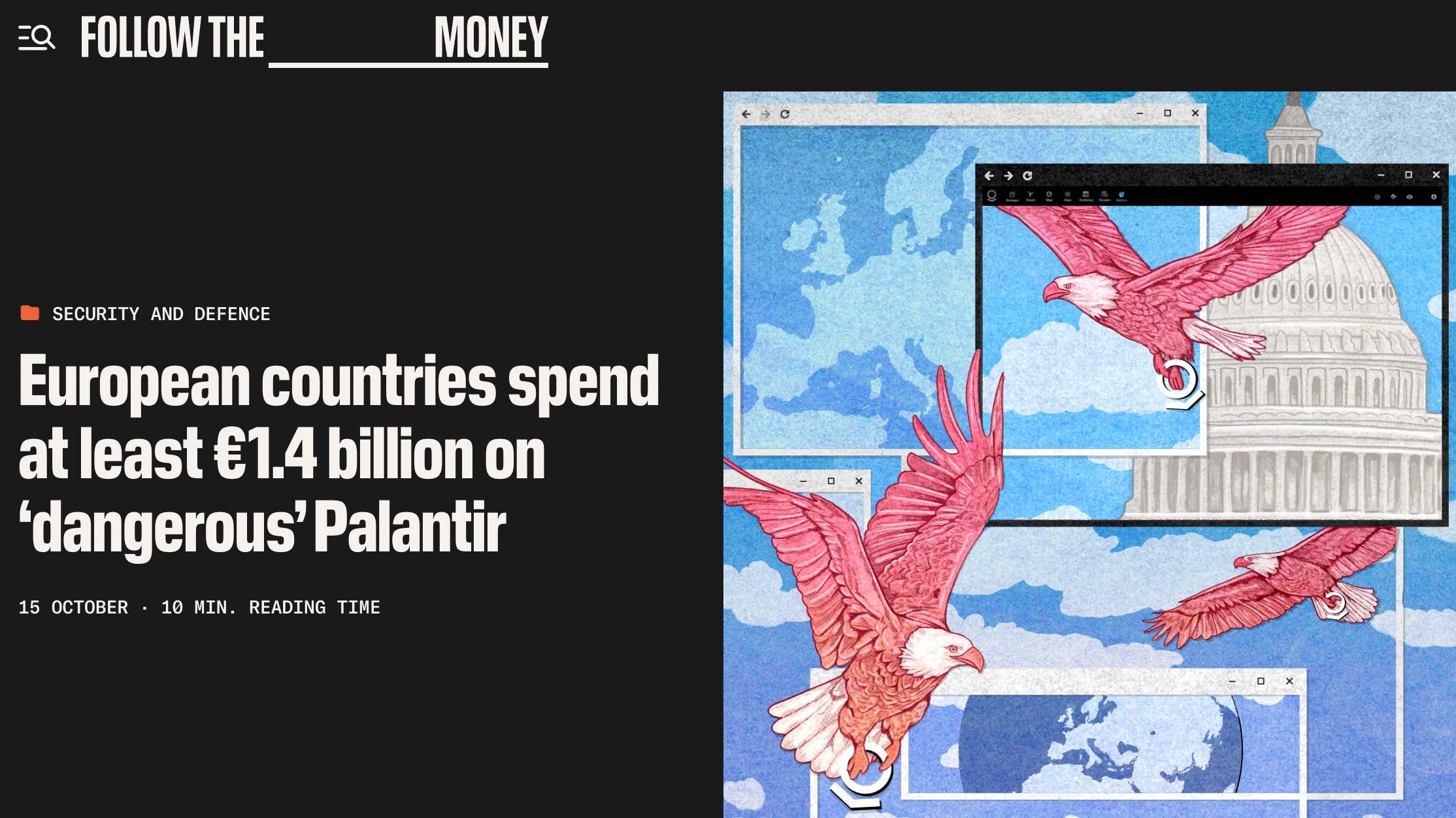
In Europe, a cooperative investigation into Palantir finds deals across defense, security and the health sector with national governments in at least 11 countries. The full volume is hard to come by, but the reporters identified contracts worth €1.4 billion, including the equivalent of €28 million from the Danish police, €25 million just in the German state of Baden-Württemberg, and €6.2 million in Italy. Check out the country-specific investigations for the Netherlands, Austria, Belgium, Denmark, Estonia, Finland, France, Germany, Greece, Israel, Italy, Lithuania, Norway, Poland, Spain, Sweden, Switzerland and the UK, the tech giant’s biggest client.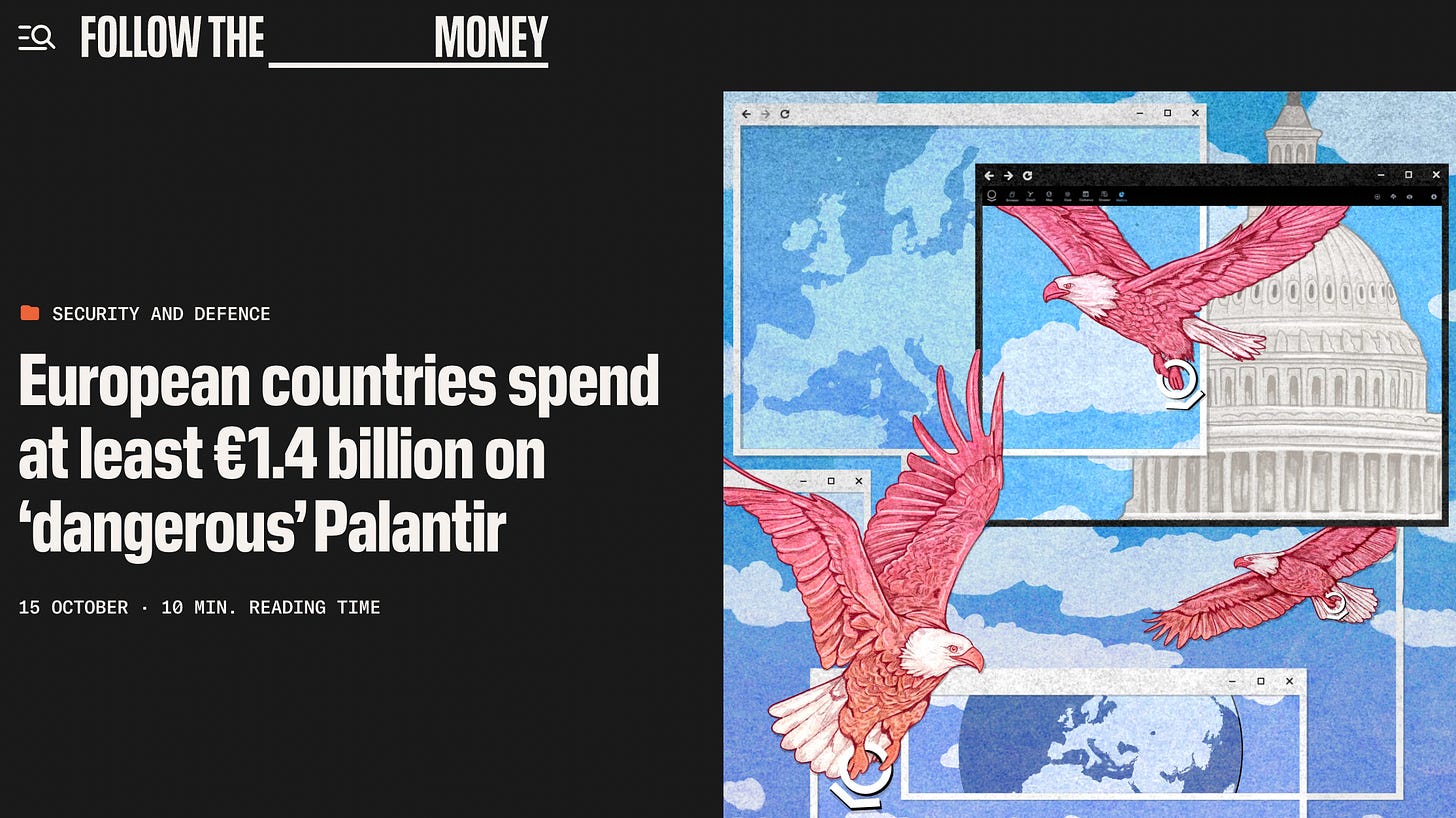
The Canadian government made over a dozen amendments to a contract which was internally flagged as “not for public disclosure” with Palantir’s Canadian subsidiary to provide services to an elite unit of the Canadian military. The contract rose from $14.4 million when it was first signed in March 2020 to about $44.4 million as of October 2025. Read the story by the Investigative Journalism Foundation’s Zac Vescera and check the record in its Open by Default database. (In total, the federal government signed nearly 2,000 secret contracts valued at $5.4 billion, IJF reveals.)
Malaysia: For Malaysiakini, Khairil Yusof and S Vinothaa examine who decides when the government guarantees billions in loans to state-owned companies. Guarantee commitments reached more than RM300 billion (around US$74 billion) in 2025, driven largely by borrowing for rail projects, such as the controversial East Coast Rail Link (ECRL). These guarantees are hard to track: they never show up in the annual budget, and the power to sign them rests with the finance minister, who can keep the details from Parliament by certifying them as confidential. OCP’s own Bernadine Fernz chips in with the simplest transparency test there is: do we know who bought what, from whom, at what price, and when? If it’s all above board, great, but nobody can tell until it’s published.
UK: The UK Covid-19 Inquiry’s Module 5 report on procurement is basically investigative catnip for the readers of this newsletter. The findings: £9.9 billion of the £14.9 billion spent on PPE was wasted. Suppliers referred through the “VIP lane” were around 13 times more likely to win a contract, paid more per item and delivered more performance problems. Yet, very little has happened when it comes to actual consequences for those who designed and devised these systems in the first place. Through the UK Anti-Corruption Coalition (UKACC), we contributed comparative, data-driven evidence to the Inquiry. Read our comment.
USA: If you’re struggling to keep up with the big beautification projects in the nation’s capital, Washington, D.C., the American Kleptocracy’s weekly has a handy overview, from bronze horses to golf courses. Dan Friedman, Will Sytsma, and Nick Schwellenbach follow the contractors fighting over immigration enforcement money in an investigation for POGO, Mother Jones and the Investigative Reporting Workshop. And ProPublica’s Aaron C. Davis and Robert Faturechi report on nearly $350 million in Pentagon contracts to one well-connected firm, including a $281 million no-bid deal.
[Data insights]
Brazil: Data agency Fiquem Sabendo used Brazil’s access to information law to get the spreadsheet of federal payments for rebuilding disaster-hit infrastructure, a total of more than R$1.1 billion (roughly US$215 million) between 2023 and September 2026. R$467 million (US$90 million), or 41% of it, went to Rio Grande do Sul, including R$326.5 million (US$63 million) for the recovery after the historic 2024 floods. The data, broken down by municipality and payment order, can be accessed here.
Bulgaria: AI-based procurement monitoring platform SIGMA tracks trends in more than 193,000 government contracts. Developed in-house by the Minister of Innovation and Digital Transformation, the platform also lists known gaps in the data. Access at https://sigma.midt.bg and public announcement here. Downloads are only available as CSV, not an API.
Beneficial ownership: Public procurement agencies often try as hard as journalists to get state buyers to publish critical information. Kenya’s procurement regulator found that about 14,800 of 26,000 contracts went to firms that never disclosed their beneficial owners, more than one in two, because the e-GP portal only asks for ownership data on open tenders. In Portugal, 60% of tenders are essentially direct awards, observes researcher Pedro Telles, based on the national procurement agency’s annual report.
Spain: Months after Spain’s ban on Israeli defense imports took effect, the city council of Oviedo awarded a four-year framework agreement for bulletproof vests to an Israeli-linked manufacturer, an investigation by Spanish watchdog Civio found. If you’re tracking sanctioned or embargoed suppliers, check our previous edition for sources on blacklisted companies.
Mexico: During political campaigns, promises abound, and promises about infrastructure even more so. W Radio’s Nayeli Roldán investigates what really happens after the photo ops, tracking San Quintín’s long-awaited hospital renovations and the contract that promised state-of-the-art technology but was never fulfilled. Three years later, the facility still lacks basic equipment such as ventilators or a working ultrasound machine.
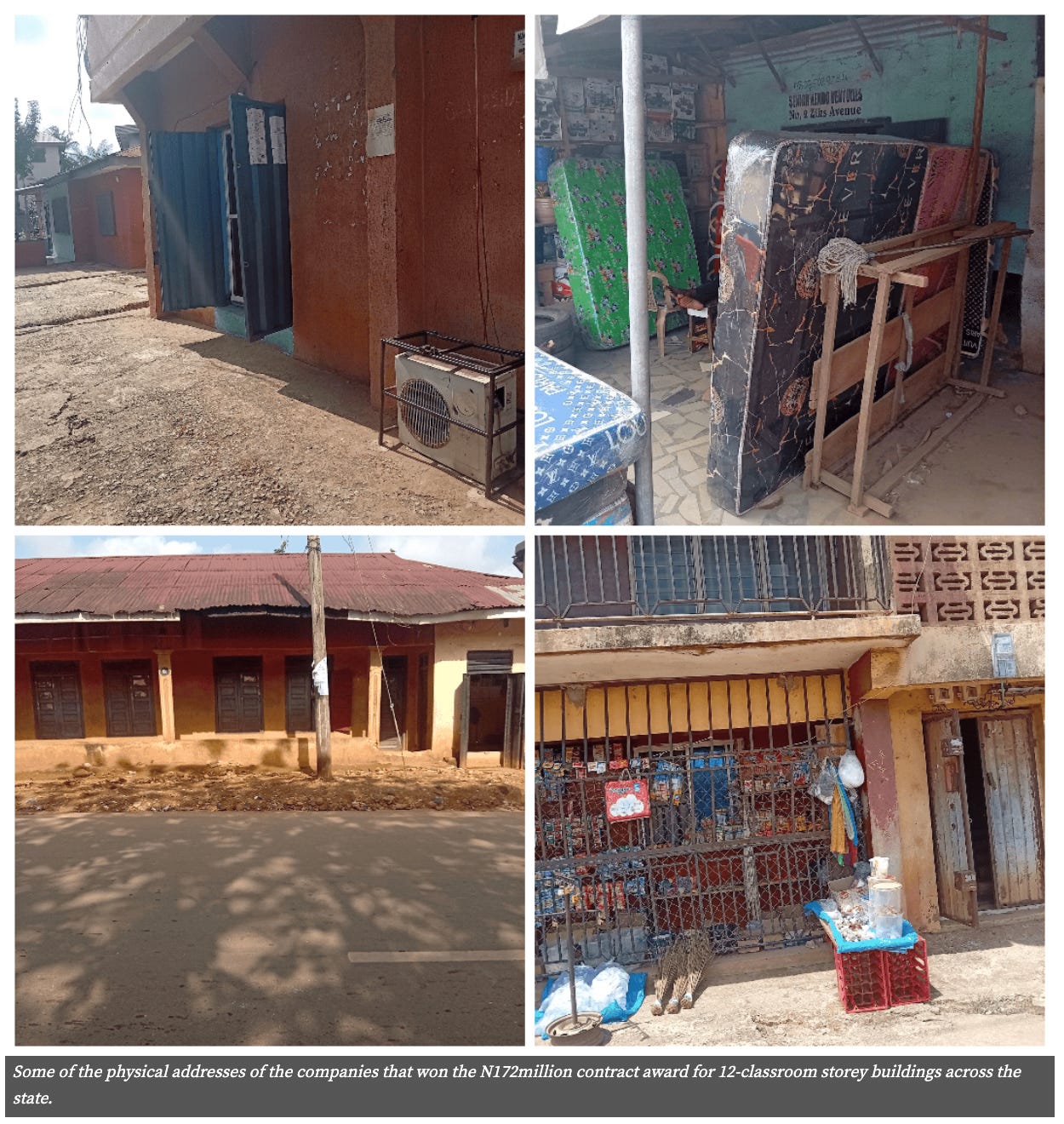
Nigeria: ICIR’s Olanrewaju Oyedeji analyzed 35 identical N172 million contracts (a total of N6.02 billion) that Ebonyi State awarded in 2024 for secondary school buildings. Using the state’s Open Contracting Data Standard portal and the company registry’s beneficial ownership data, he found sole bidders and front companies, including a mattress shop and a residential building, and winners linked to the governor’s brother-in-law, the Speaker’s relative and the governor’s own aides.
Albania: Kapital obtained documents on a classified €15 million Ministry of Defence tender for three firefighting aircraft. The winner, Air Tractor Europe, was convicted by a Spanish court in the so-called Fire Cartel bid-rigging case, and Greece’s Supreme Court canceled a €154.8 million award earlier this year due to its prior conviction.
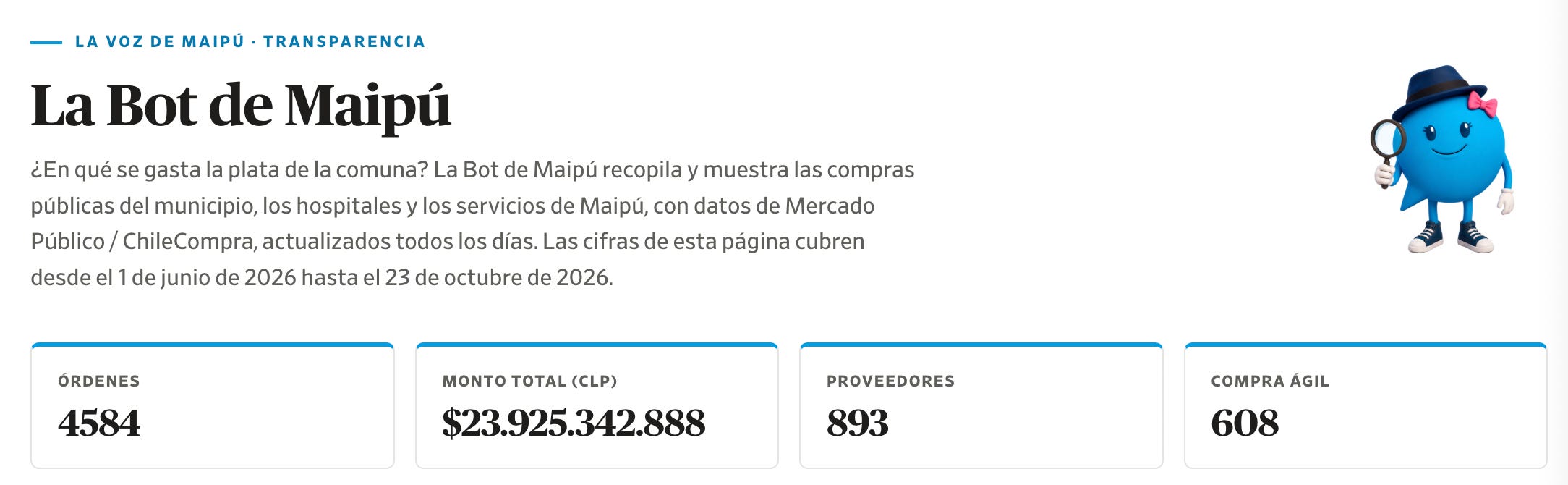
Chile: Local news outlet La Voz de Maipú built La Bot de Maipú to track spending in its municipality, located outside of the capital city Santiago. Particularly valuable is a listing of companies winning one or more below-threshold contracts to identify potential contract splitting. The tool runs on ChileCompra’s Mercado Público API and is updated daily. Alfredo Albornoz’s behind-the-scenes write-up is useful for other small media organizations, focusing on low cost architecture and why “open data” isn’t “ready data”. They’re offering the code to other local newsrooms too.
[Tips from practitioners]
For GIJN, Mkhululi Chimoio spoke to East African journalists who use procurement data to investigate corruption, including some stories we’ve covered here in the past – and the Nigeria story above.
Some of our favourite quotes:
Eric Mugendi, managing editor at Kenya’s investigative newsroom Africa Uncensored, sums it up well:
“Procurement data is more than just numbers. It shows what a country cares about, who holds power, and where abuses occur. If journalists can figure it out, they can show who got rich and how corruption leads to empty clinics, fake schools, and unfinished roads.”
For investigative journalist Mungai Ngige, the hardest part of procurement investigations often involves linking contracts to the people who profit from them. He says open data is essential.
“Company records, court papers, and procurement records show directors, shareholders, and incorporation dates. Even small details, like shared phone numbers, can reveal hidden connections.”
[Data tools & resources]
We are seeing an increasing number of AI-supported investigative tools, making procurement-related data more accessible and enabling links to other data sources.
A couple that might be useful:
OpenCheck is a due diligence tool that takes any legal entity and checks it against the GLEIF’s legal entity reference data, national company registries and OpenSanctions, with results mapped to the Beneficial Ownership Data Standard. It is built by Stephen Abbot Pugh, formerly of Open Ownership.
When your investigation is stuck in the chatbot, Reinaldo Chaves of Abraji shares a set of open source intelligence (OSINT) tools for investigative journalists, including a Claude plug-in for transnational due diligence, a server to access the OpenFEC data, and a toolkit for visual verification, geolocation, and social-media triangulation.
Price Benchmark, a cool personal project by Federico Giudici that determines reference prices for products across seven countries, using open contracting data published by procurement agencies in Chile, Dominican Republic, Honduras, Paraguay, Peru, Uruguay, and Zambia.
This newsletter has been put together by Georg Neumann at Open Contracting Partnership with editing by Sophie Brown. Thanks for reading. Do give us a like if you’ve enjoyed the read. Did a friend forward you this email?
"Open data isn't ready data" is the line I'd underline. I put together a weekly newsletter for US veteran-owned contractors from SAM.gov's public opportunity file and USAspending, and most of the work is joining the two: a solicitation often doesn't name the contract it replaces, so tying an open bid to its likely incumbent takes inference, and we label those calls as inferred. La Bot de Maipú's below-threshold listing is a smart idea to borrow, since repeat small awards to the same vendor are exactly where splitting hides.
The UK Covid Inquiry Module 5 figures are the ones that still sit in the tender record: £9.9 billion of the £14.9 billion spent on PPE was wasted, and VIP lane suppliers were around 13 times more likely to win, paid more per item and delivered more problems. The Procurement Act now asks buyers to publish more notices and assessment summaries, which would make a parallel lane much harder to hide, but only if those notices are complete and timely. The transparency test quoted here is the right one for any public digital or health contract too: who bought what, from whom, at what price, and when. If that trail is missing, the market cannot see the award and cannot challenge it.